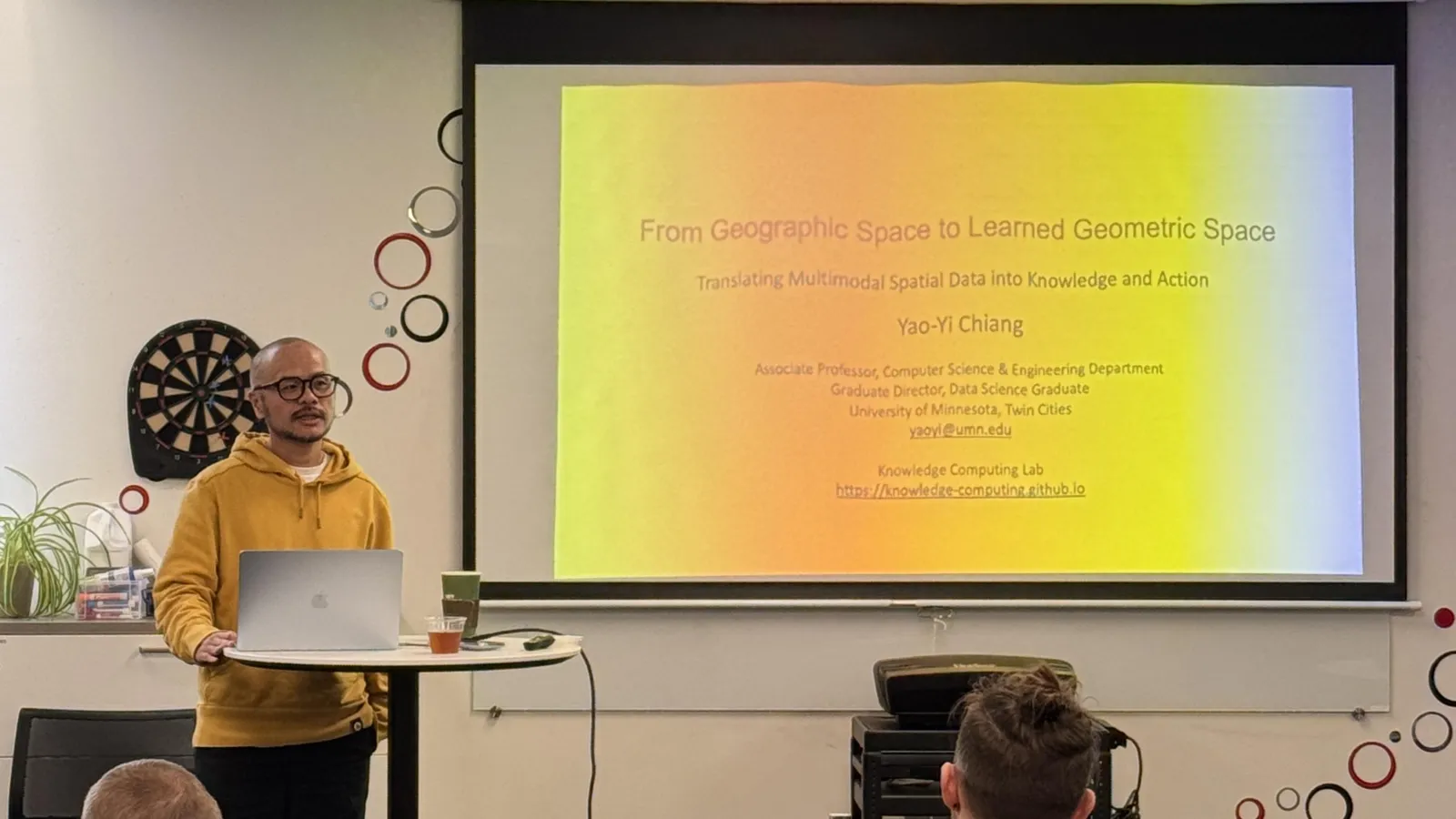
Seminar and Workshop Explore Spatial AI Through a Geometric Lens
The Translational Data Analytics Institute (TDAI) hosted a seminar and interactive workshop on March 11–12, 2026 featuring Dr. Yao-Yi Chiang, Associate Professor of Computer Science & Engineering at the University of Minnesota. The events were part of TDAI’s Geometrization of AI research theme, led by faculty members Dena Asta and Subhadeep Paul.
During the seminar, From Geographic Space to Learned Geometric Space, Dr. Chiang explored how many machine learning systems working with spatial data rely on predefined assumptions about similarity, such as geographic distance or lexical similarity between place names. He presented new representation learning approaches that instead construct learned embedding spaces grounded in geographic and environmental context, enabling improved spatial prediction, alignment between geographic data and language, and stronger model interpretability.
The following day’s interactive workshop expanded on these ideas through discussion of emerging research directions in Spatial AI, spatiotemporal embeddings, and multimodal geographic data integration. Faculty and graduate students from Ohio State shared short research presentations, which helped frame collaborative discussions on interpretability, robustness, and the challenges of modeling complex spatial environments.
Together, the seminar and workshop highlighted how geometric perspectives can provide powerful tools for understanding and designing modern AI systems. The events also advanced ongoing dialogue within TDAI’s Geometrization of AI theme, which explores how geometric structures and representation spaces shape the behavior, capabilities, and interpretability of artificial intelligence.