Geometrization of AI events connect mathematical foundations with AI ethics

Ohio State researchers examined how mathematical concepts can inform AI ethics during an October 28–29 seminar and workshop hosted by the Translational Data Analytics Institute. Part of TDAI’s Geometrization of AI yearlong theme, the events connected research in mathematics and philosophy around questions of ethical reasoning, AI consciousness and human relationships with AI.
Led by Dena Asta and Subhadeep Paul, the theme brings researchers across disciplines together to explore geometric approaches to understanding artificial intelligence. The October events focused that work on ethics: how mathematical structures might help researchers formulate moral principles and evaluate AI systems.
In his seminar, “Symmetry, Invariance and Deontology,” Jonathan Simon of Université de Montréal approached Kant’s categorical imperative as an invariance principle. The central question was whether an ethical rule remains valid when the identities and circumstances of those involved change. Simon explored refinements to Kant’s formulation that could address longstanding philosophical objections and help make the concept of a Kantian agent mathematically and computationally rigorous, with potential applications in AI safety.
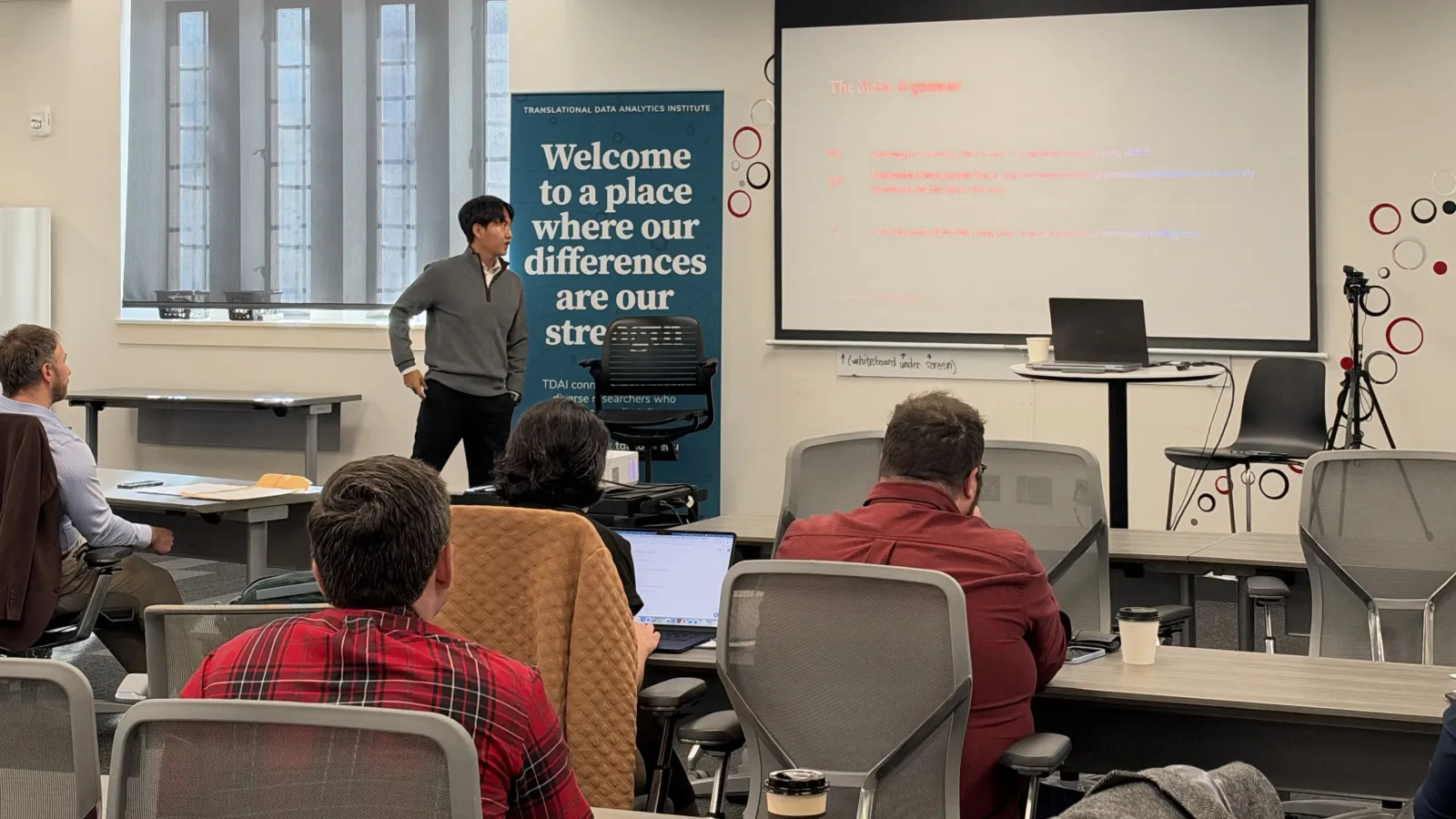
The next morning’s workshop, “Geometric Formalizations of Ethics in AI,” brought Ohio State philosophy and mathematics researchers together in Pomerene Hall to examine related research questions.
Matthew Willis addressed the risks of AI-mediated inquiry, while Inchul Yum examined AI companions and the symmetry of affective relationships. Declan Smithies explored AI consciousness and moral status. Sanjeevi Krishnan presented on behavioral analysis of high-dimensional spaces, and Dustin Mixon contributed “From prompts to proofs to people.”
The two-day program connected the theme’s mathematical foundations with concrete questions about AI: how systems influence knowledge, what relationships with artificial agents entail and what could establish an AI system’s moral status. These questions create shared research ground for mathematicians and philosophers working to understand AI’s capabilities and ethical implications.